An unofficial blog that watches Google's attempts to move your operating system online since 2005. Not affiliated with Google.

Send your tips to gostips@gmail.com.
Showing posts with label Google Health. Show all posts

December 15, 2010

Google Body Browser

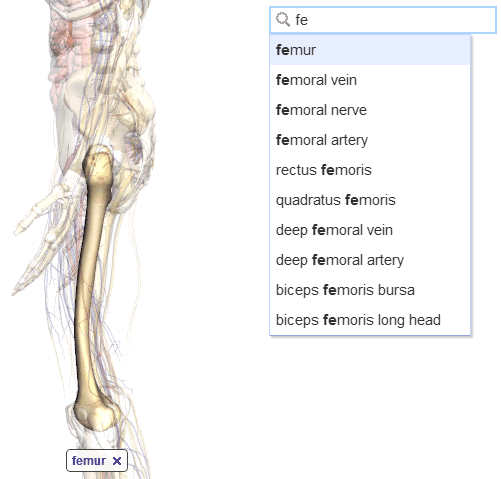
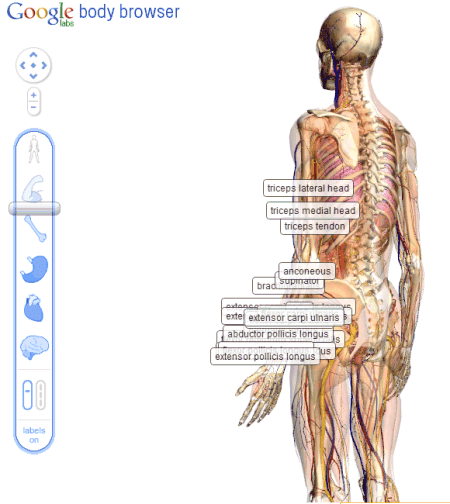
Google has recently demoed an interesting WebGL application called Body Browser, which lets you explore the human body just like you can explore the world in Google Earth. Now you can try Google Body Browser before it's added to Google Labs, assuming that you have a WebGL-enabled browser:

* WebGL is available, but not enabled by default in Chrome 8 (the latest stable version). Type about:flags in the address bar, click "Enable" next to "WebGL" and then click on "Restart now". Please note that this is an experimental feature in Chrome 8.
* WebGL is enabled by default in Chrome 9 Beta, Chrome 9 Dev Channel, Chrome Canary Build and Firefox 4 beta.


Damon Hernandez was surprised to notice that the application doesn't require a plugin. "Unlike other web based medical applications I have seen, no Flash, Java, or other plugins are needed. This application will run on any WebGL supported browser. (...) Last year I got the opportunity to work on an open standards based web3D medical app for learning the bones of the body. After witnessing how that app really helped students learn the bones, I am sold on using web3D for medical education."

Here's Google's demo:


{ Thanks, Juuso. }

August 27, 2009

Google Health OneBox

Search Engine Land reports that Google added an OneBox for health-related information that's only displayed in the US. If you search for [flu], [ADHD], [autism] and other medical conditions, you'll see an excerpt from a Google Health article and links to other services: Mayo Clinic, Medline Plus, WebMD.

Most likely, some of the keywords that trigger the OneBox are displayed on this page. Google Health's articles combined information licensed from reputable sources with information from scholar papers, news articles and other web pages.


May 19, 2008

Google Health Launches

After a year and a half since the first announcement, the much-anticipated Google Health has been released at Google Factory Tour of Search. "Patients need to be able to better coordinate and manage their own health information. We believe that patients should control and own their own health information, and should be able to do so easily," said Adam Bosworth in November 2006.


Here's what you can do in Google Health:
* create a health profile with information about your health conditions, medications, allergies
* import medical records from US hospitals that use Google's APIs to make the conversion possible. Unfortunately, the list of partners is almost empty.
* read medical resources, information about diseases


* find a doctor using Google Local Search
* use other health services that integrate with Google Health and can can import your data securely and use it for different purposes: calculate the heart attack risk, print your health history or share it with doctors. According to the FAQ, "Google Health is a PHR (Personal Health Record), but it is also a bit of a different model. We believe it's not enough to offer a place where you can store, manage, and share your health information. You need to act on your health information to better manage your health needs on a daily basis. This is why we provide a directory of online health services to you. You must elect to sign up with a service and decide what level of personal data you want to share in exchange for the customized services those companies offer."

Google Health wants to become the central place where you organize your health information and share it with people or services you trust. Since this information is very sensitive, Google takes a lot of precautions by using SSL connections and a separate privacy policy that clearly states: "You control who can access your personal health information. By default, you are the only user who can view and edit your information. If you choose to, you can share your information with others."

This is a big test of trust for Google and probably the most personal service ever offered by the company. While you can also enter your credit card information in Google Checkout, your location in iGoogle or Google Maps, personal information in orkut, Blogger and YouTube, Google Health is about your existence.

"Health information is very fragmented today, and we think we can help. Google believes the Internet can help users get access to their health information and help people make more empowered and informed health decisions. People already come to Google to search for health information, so we are a natural starting point," says Google. But there's a big difference between offering general health information and storing health records, so it will be interesting to see if Google manages to convince users that this shift is beneficial to them. Google could integrate more health information in the search results, the same way Microsoft shows information from HealthVault in Live Search and lets you collect it in your account. TechCrunch says that "Google promises never to advertise on Google Health".

(Small tidbits: Google Health is one of the very few Google applications created using Google Web Toolkit and its codename seems to be Weaver.)
March 2, 2008

More Details About Google Health

This week we found more details about Google Health, a not-yet-released service for managing personal health information. Marissa Mayer showed us some screenshots and the underlying principles of Google Health:
One of the most exciting and innovative parts of Google Health is our platform strategy. We're assembling a directory of third-party services that interoperate with Google Health. Right now, this means you'll be able to automatically import information such as your doctors' records, your prescription history, and your test results into Google Health in order to easily access and and control your data. Later, this platform strategy will mean that you will be able to interact with services and tools easily, and will be able to do things like schedule appointments, refill prescriptions, and start using new wellness tools.


Google sponsored the research of George Church, a scientist that "plans to unlock the secrets of common diseases by decoding the DNA of 100,000 people in the world's biggest gene sequencing project". Asked if Google Health could make it easy to access genetics services, Marissa Mayer said: "We have some genetic partners where we've already been making investments. Genetics is much further out, and will be done at the control and discretion of the user."

Eric Schmidt explained that the idea for launching a health service came after looking at Google Search data. "[We] looked at what do people actually do with search in terms of the volume, and the importance of health came out No. 1... We tend to think of Google Health as an extension of search."

The service is likely not to include advertising since it will encourage people to use Google Search more. Google's CEO gave Google News as an example of non-monetized service: "Every month we say to ourselves should we add ads to Google News or add more news features to Google News and every month we decide to add more Google news features. (...) A Google News user is more likely to be a Google searcher and therefore clicks on ads more."

Eric Schmidt also gave an interesting keynote speech at the Healthcare Information and Management Systems Society conference (a YouTube user comments: "As ever Eric Schmidt is knowledgeable, funny and engaging").

February 21, 2008

Cleveland Clinic to Test Google Health


More than a year after Google started developing a service for storing and managing health records, Cleveland Clinic will be the first test a pre-release version of the service. From a prototype revealed last year, we could see that Google Health intends to help you make more informed decisions about your health by putting you in control of your health information.

Cleveland Clinic will start to test the service on at least 1,500 patients. "It will test secure exchange of patient medical record data such as prescriptions, conditions and allergies between their Cleveland Clinic PHR to a secure Google profile in a live clinical delivery setting. The ultimate goal of this patient-centered and controlled model is to give patients the ability to interact with multiple physicians, healthcare service providers and pharmacies. (...) The pilot will eventually extend Cleveland Clinic's online patient services to a broader audience while enabling the portability of patient data so patients can take their data with them wherever they go — even outside the Cleveland Clinic Health System."

The big benefits are that health records become portable, more accessible and more useful, while still being stored securely. Despite the benefits, people might not feel comfortable with storing sensitive data online.

According to New York Times, Google Health will be publicly available after the pilot ends, in around two months.

Microsoft launched in October 2007 its own health service called HealthVault that has similar goals with Google's initiative, while partnering with a number of important medical institutions. It's not the only existing service for managing personal health records online, but their use didn't become widespread, not even in the US.

Update: Google Blog mentions that Google Health uses GData and standard medical information formats. "Patients participating in the Cleveland pilot give authorization via our AuthSub interface to have their electronic medical records safely and securely imported into a Google account. (...) Cleveland is just the first of many healthcare providers that will securely send medical records and information via Google APIs at your request. We've been hard at work collaborating with a number of insurance plans, medical groups, pharmacies and hospitals."

August 14, 2007

Google Health Prototype


New York Times reports that Google's plans for a service that puts you in control of your health information start to take shape. This service could help you make more informed decisions about your health, get personalized recommendations from specialists and share this information with other people.
A prototype of Google Health, which the company has shown to health professionals and advisers, embodies the consumer-centered philosophy. The welcome page reads, "At Google, we feel patients should be in charge of their health information, and they should be able to grant their healthcare providers, family members, or whomever they choose, access to this information. Google Health was developed to meet this need."

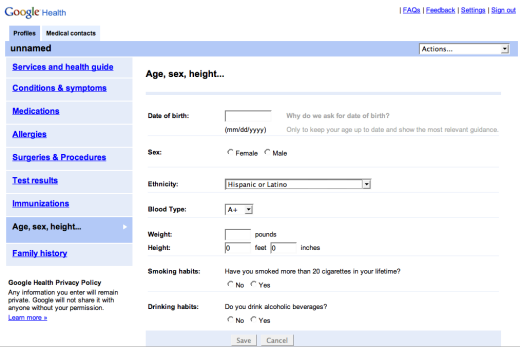
A presentation of screen images from the prototype - which two people who received it showed to a reporter - then has 17 other Web pages including a "health profile" for medications, conditions and allergies; a personalized "health guide" for suggested treatments, drug interactions and diet and exercise regimens; pages for sharing information, receiving reminder messages to get prescription refills or visit a doctor, and pages to access directories for nearby physicians and specialists.


More about Google Health straight from the horse's mouth:

* Health care information matters - "Health information should be easier to access and organize, especially in ways that make it as simple as possible to find the information that is most relevant to a specific patient's needs."

* How do you know you're getting the best care possible? - "There is a lot of material out there about drugs, diseases, procedures and treatments. How do you know what is trustworthy and what isn't? Search is great at finding us places with relevant information, but it is hard to know which links are reliable and which are less so."

* Is there a doctor in the family? - "We have been talking to many medical experts to understand what the best guidelines are, and how we can determine which ones apply in different circumstances. If such guidelines were more available to patients, they might be able to, by inputting information such as age, gender or medications, learn about recommended screening tests and other preventive measures, or about harmful drug interactions."

* Some screenshots of the prototype.

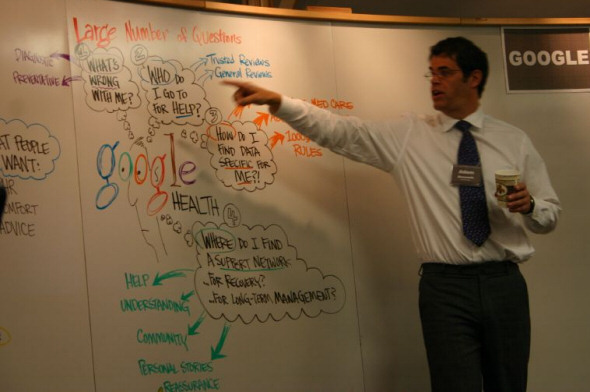
{ The first screenshot is licensed as Creative Commons by Philipp Lenssen. The second image, where you can see Adam Bosworth (VP at Google and Google Health's architect), is licensed as Creative Commons by AlphachimpStudio. }

December 10, 2006

A URL for Your Health Records

Health is a complicated subject: usually you care about it only when there's something wrong. Google's Adam Bosworth realized people aren't in control of their own health information.

"There is no place individuals can go to get a comprehensive set of health and medical information about themselves. Access to this comprehensive information can be vital to proper and timely diagnosis of the patient, to the patient getting the best possible treatment, and, perhaps sometimes overlooked, to the patient getting the best possible ongoing care and support after the initial treatment, especially for chronic illnesses. (...)

We need to put control into the hands of the sick and their caregivers and to gently suggest that those who treat them, medicate them, test them, or diagnose them, are out of date if they do not instantly deliver this information to the patient. Once this happens, we will see truly great decision support systems and specialists and health coaches help the hapless patients much more rapidly determine what is truly wrong with them."

Your health record can be shared between healthcare providers if that's necessary, so an easy-to-access health URL that works like a private Google Docs document, to which you can invite people, is just an evolution.

This is one of the preconditions of a Google Health product, that manages health records and helps people use them better.