It is innovation's biggest paradox: We demand more and more from the stuff in our lives--more features, more function, more power--and yet we also increasingly demand that it be easy to use. And, in an Escher-like twist, the technology that's simplest to use is also, often, the most difficult to create.
Marissa Mayer lives with that conundrum every day. As Google's director of consumer Web products, she's responsible for the search site's look and feel. Mayer is a tall, blond 30-year-old with two Stanford degrees in computer science and an infectious laugh. She's also Google's high priestess of simplicity, defending the home page against all who would clutter it up. "I'm the gatekeeper," she says cheerfully. "I have to say no to a lot of people."
The technology that powers Google's search engine is, of course, anything but simple. In a fraction of a second, the software solves an equation of more than 500 million variables to rank 8 billion Web pages by importance. But the actual experience of those fancy algorithms is something that would satisfy a Shaker: a clean, white home page, typically featuring no more than 30 lean words; a cheery, six-character, primary-colored logo; and a capacious search box. It couldn't be friendlier or easier to use.
Here is how Mayer thinks about the tension between complexity of function and simplicity of design: "Google has the functionality of a really complicated Swiss Army knife, but the home page is our way of approaching it closed. It's simple, it's elegant, you can slip it in your pocket, but it's got the great doodad when you need it. A lot of our competitors are like a Swiss Army knife open--and that can be intimidating and occasionally harmful."
It would be lovely if Google's corporate mythology included an enchanting tale to account for the birth of this pristine marvel. But the original home-page design was dumb luck. In 1998, founders Sergey Brin and Larry Page were consumed with writing code for their engine. Brin just wanted to hack together something to send queries to the back end, where the cool technology resided. Google didn't have a Web master, and Brin didn't do HTML. So he designed as little as he could get away with.
The accident became an icon, of course, and a key reason the company enjoys a commanding lead. Google's design has been mimicked on the search pages of MSN and Yahoo, whose portals are messy throwbacks to the "everything but the kitchen sink" school of Web design. But they're poor imitations; according to Hitwise, Google controls 59.2% of the search market, up from 45% a year ago; MSN's share is down to 5.5% and Yahoo's is 28.8%.
With Google's extraordinary trajectory and the stratospheric success of Apple's iPod--itself a marvel of simplicity and, with 20 million units sold, a staggering hit--we seem to be nearing a seminal moment. Whereas endless Sunday Styles stories may have failed to get its attention, the tech industry's interest is invariably galvanized by cash. If the equation T (technology) + E (ease of use) = $ can be proven, the time may be right for the voice of the technologically challenged who can't operate their remotes to be heard.
In a 2002 poll, the Consumer Electronics Association discovered that 87% of people said ease of use is the most important thing when it comes to new technologies. "Engineers say, 'Do you know how much complexity we've managed to build in here?' But consumers say, 'I don't care. It's just supposed to work!' " says Daryl Plummer, group vice president at Gartner Group.
It's often that tension--between the desire to cram in cool new features and the desire to make a product easy to use--that makes delivering on the simplicity promise so hard, particularly in companies where engineers hold sway. At Google, it's an ongoing battle. As developers come up with ever sexier services--maps! news alerts! scholarly papers!--the pressure to lard on links is fierce. Mayer holds them at bay with a smile and strict standards.
To make it to the home page, a new service needs to be so compelling that it will garner millions of page views per day. Contenders audition on the advanced-search page; if they prove their mettle--as image search did, growing from 700,000 page views daily to 2 million in two weeks--they may earn a permanent link. Few make the cut, and that's fine. Google's research shows that users remember just 7 to 10 services on rival sites. So Google offers a miserly six services on its home page. By contrast, MSN promotes more than 50, and Yahoo, over 60. And both sell advertising off their home pages; Google's is a commercial-free zone.
So why don't those sites simply hit the delete button and make their home pages more Googlesque? Hewing to the simplicity principle, it turns out, is tougher than connecting with tech support, particularly if you try it retrospectively. "Once you have a home page like our competitors'," Mayer says, "paring it back to look like Google's is impossible. You have too many stakeholders who feel they should be promoted on the home page." (MSN says more than half its customers are happy with its home page--but it's experimenting with a sleeker version called "start.com.")
Google understands that simplicity is both sacred and central to its competitive advantage. Mayer is a specialist in artificial intelligence, not design, but she hits on the secret to her home page's success: "It gives you what you want, when you want it, rather than everything you could ever want, even when you don't."
To read more, visit The Beauty of Simplicity.
December 29, 2005
December 28, 2005
Top 5 Google acquisitions
5.
Urchin Software (March 2005), Web Analytics software.
Urchin is a web site analytics solution used by web site owners and marketers to better understand their users’ experiences, optimize content and track marketing performance.
4.
Pyra Labs (February 2003), editor of Blogger, blogging platform.
3.
Keyhole (October 2004), imagery by satellite.
Keyhole’s technology combines a multi-terabyte database of mapping information and images collected from satellites and airplanes with easy-to-use software.
2.
Kaltix (September 2003). Research on personalized search, from Taher Haveliwala, Glen Jeh, and Sepandar Kamvar.
Kaltix Corp. was formed in June 2003 and focuses on developing personalized and context-sensitive search technologies that make it faster and easier for people to find information on the web.
1.
Applied Semantics (April 2003), contextual advertising.
Applied Semantics’ products are based on its patented CIRCA technology, which understands, organizes, and extracts knowledge from websites and information repositories in a way that mimics human thought and enables more effective information retrieval.
Urchin Software (March 2005), Web Analytics software.
Urchin is a web site analytics solution used by web site owners and marketers to better understand their users’ experiences, optimize content and track marketing performance.
4.
Pyra Labs (February 2003), editor of Blogger, blogging platform.
3.
Keyhole (October 2004), imagery by satellite.
Keyhole’s technology combines a multi-terabyte database of mapping information and images collected from satellites and airplanes with easy-to-use software.
2.
Kaltix (September 2003). Research on personalized search, from Taher Haveliwala, Glen Jeh, and Sepandar Kamvar.
Kaltix Corp. was formed in June 2003 and focuses on developing personalized and context-sensitive search technologies that make it faster and easier for people to find information on the web.
1.
Applied Semantics (April 2003), contextual advertising.
Applied Semantics’ products are based on its patented CIRCA technology, which understands, organizes, and extracts knowledge from websites and information repositories in a way that mimics human thought and enables more effective information retrieval.
Google Pays AOL $1 Billion For 5 Percent
CNN/ Reuters report the Google/AOL deal is final now:
“America Online said Google had agreed to invest $1 billion to take a 5 percent stake in AOL, as part of an enhanced pact where Google will move beyond text-based advertising to allow AOL to sell graphical ads to Google’s fast-growing ad network.”
Here’s the press release on the Google/ AOL “alliance.” Some key issues:
* Creating an AOL Marketplace through white labeling of Google’s advertising technology - enabling AOL to sell search advertising directly to advertisers on AOL-owned properties;
* Expanding display advertising throughout the Google network;
* Making AOL content more accessible to Google Web crawlers;
* Collaborating in video search and showcasing AOL’s premium video service within Google Video;
* Enabling Google Talk and AIM instant messaging users to communicate with each other, provided certain conditions are met; and
* Providing AOL marketing credits for its Internet properties.
“America Online said Google had agreed to invest $1 billion to take a 5 percent stake in AOL, as part of an enhanced pact where Google will move beyond text-based advertising to allow AOL to sell graphical ads to Google’s fast-growing ad network.”
Here’s the press release on the Google/ AOL “alliance.” Some key issues:
* Creating an AOL Marketplace through white labeling of Google’s advertising technology - enabling AOL to sell search advertising directly to advertisers on AOL-owned properties;
* Expanding display advertising throughout the Google network;
* Making AOL content more accessible to Google Web crawlers;
* Collaborating in video search and showcasing AOL’s premium video service within Google Video;
* Enabling Google Talk and AIM instant messaging users to communicate with each other, provided certain conditions are met; and
* Providing AOL marketing credits for its Internet properties.
Top Google searches in 2005
Google.com - Top Gainers of 2005
1. Myspace
2. Ares
3. Baidu
4. wikipedia
5. orkut
6. iTunes
7. Sky News
8. World of Warcraft
9. Green Day
10. Leonardo da Vinci
Google News - Top Searches in 2005
1. Janet Jackson
2. Hurricane Katrina
3. tsunami
4. xbox 360
5. Brad Pitt
6. Michael Jackson
7. American Idol
8. Britney Spears
9. Angelina Jolie
10. Harry Potter
Froogle - Top Searches in 2005
1. ipod
2. digital camera
3. mp3 player
4. ipod mini
5. psp
6. laptop
7. xbox
8. ipod shuffle
9. computer desk
10. ipod nano
More top searches.
1. Myspace
2. Ares
3. Baidu
4. wikipedia
5. orkut
6. iTunes
7. Sky News
8. World of Warcraft
9. Green Day
10. Leonardo da Vinci
Google News - Top Searches in 2005
1. Janet Jackson
2. Hurricane Katrina
3. tsunami
4. xbox 360
5. Brad Pitt
6. Michael Jackson
7. American Idol
8. Britney Spears
9. Angelina Jolie
10. Harry Potter
Froogle - Top Searches in 2005
1. ipod
2. digital camera
3. mp3 player
4. ipod mini
5. psp
6. laptop
7. xbox
8. ipod shuffle
9. computer desk
10. ipod nano
More top searches.
December 20, 2005
PCWorld is evil, Google is not
Exclusive from PCWorld: winners and losers of 2005.
This is the last post in 2005. Merry Christmas and a Happy New Year. May your hearts be filled with joy and warm love. May your ideas sparkle in 2006.
Happy New Year, Google!
WINNER: Google
Meet your new best friends, Sergey and Larry. Want a free e-mail account? No problem. A blog? Satellite maps? How about a searchable library of every book ever written? Here, have some free Wi-Fi. Oh, and don't forget to enter the stuff you want to sell into Google's new classified ad/online garage sale/whatever-you-want database. No charge, and no need to say thanks. Remember that silly dot-com-era notion that you could make money by giving things away? Guess what? It actually works!
LOSER: Google
What does a company with staggering amounts of computing power, the world's best brains, and a share price north of $400 do? Anything it darn well pleases. But the next thing you know it's getting sued for copyright violations by the Association of American Publishers and becoming part of the hacker's tool kit. Google's seemingly unquenchable ambition and near-monopoly on everything it touches--otherwise known as "Microsoft Syndrome"--is making more and more people nervous.
This is the last post in 2005. Merry Christmas and a Happy New Year. May your hearts be filled with joy and warm love. May your ideas sparkle in 2006.
Happy New Year, Google!
What's your personality?
Take the Jung test to find out.
That's what I found about me.
INTJ
"Mastermind"
Introverted intellectual with a preference for finding certainty. A builder of systems and the applier of theoretical models. 2.1% of total population.
That's what I found about me.
INTJ
"Mastermind"
Introverted intellectual with a preference for finding certainty. A builder of systems and the applier of theoretical models. 2.1% of total population.
Create your own shortcuts on Yahoo
Yahoo extended their Search Shortcuts that allowed you to go to trigger shortcuts to special searches (news, video, image), simple answers (zip code, weather, calculator, definition) or interesting facts (information about patents, vehicle history using the 17-character Vehicle Identification Number, book price finder using its ISBN, manufacurer of a product using its 12-digits UPC code).
Now you can define your own shortcuts. Open Shortcuts are custom keywords that take you directly to a site, a search, or start a task right from the search box. In Unix speak: if the search box is the command-line of the web, shortcuts are aliases.
To use an Open Shortcut, you type ! (exclamation point) followed by the name of the shortcut in the Yahoo! Search box. For example, type: !ebay lamps. This takes you directly to www.ebay.com and searches for lamps.
You can create your own shortcuts to:
* Instantly navigate to any URL on the Internet
* Easily recall common searches on Yahoo!
* Quickly search favorite sites
* Jump start frequently used Internet applications
To create a navigational shortcut, use the keyword: !set with your shortcut name and destination URL.
!set shortcut_name URL
Try this
!set gops http://www.google.com/search?&q=%s+site%3Agooglesystem.blogspot.com
to set a shortcut for a search in this blog.
Some cool examples:
!mail sergey@google.com -- Compose a mail to Sergey Brin.
!wiki Sergey Brin -- Find information about Sergey Brin from Wikipedia.
!news Sergey Brin -- Search latest news about Sergey Brin.
The complete list of shortcuts.
Now you can define your own shortcuts. Open Shortcuts are custom keywords that take you directly to a site, a search, or start a task right from the search box. In Unix speak: if the search box is the command-line of the web, shortcuts are aliases.
To use an Open Shortcut, you type ! (exclamation point) followed by the name of the shortcut in the Yahoo! Search box. For example, type: !ebay lamps. This takes you directly to www.ebay.com and searches for lamps.
You can create your own shortcuts to:
* Instantly navigate to any URL on the Internet
* Easily recall common searches on Yahoo!
* Quickly search favorite sites
* Jump start frequently used Internet applications
To create a navigational shortcut, use the keyword: !set with your shortcut name and destination URL.
!set shortcut_name URL
Try this
!set gops http://www.google.com/search?&q=%s+site%3Agooglesystem.blogspot.com
to set a shortcut for a search in this blog.
Some cool examples:
!mail sergey@google.com -- Compose a mail to Sergey Brin.
!wiki Sergey Brin -- Find information about Sergey Brin from Wikipedia.
!news Sergey Brin -- Search latest news about Sergey Brin.
The complete list of shortcuts.
December 19, 2005
Will Google fall in 2006?
David Kirkpatrick, senior editor at Fortune, says that Google will falter in 2006.
Google's response to Yahoo's My Web is Personalized Search, but the current implementation makes it hard for a user to rate a website or to categorize it. The bookmarking system is quite feeble. Integration with Google Toolbar and creation of a community with trusting hierarchies will be next challenges for Google.
Yes, I love Google, but my first prediction is that a year from now we won't think that the search company is the invincible behemoth that we do now.
Take a new concept known as "community-powered search." Yahoo is forging an early lead over Google in this fast-evolving technology with its acquisition last week of del.icio.us for a rumored $35 million (the actual amount was undisclosed). Del.icio.us operates on principles similar to the popular MySpace. But whereas that social network site helps members find dates, form groups, and share music picks, del.icio.us helps members find hot information--websites that others have found useful.
Soon we will see a new form of results, like "What Others Liked," on all search engines. It's how Amazon tells its customers what others have bought, except that these search results involve information. In many cases, community-powered searches will let members find what they're looking for more quickly than they would on a purely computerized type of web search, which Google does so superbly. Yahoo was already introducing community-based searches with >My Web 2.0. Of course, Google is surely working on its own alternatives.
Google's response to Yahoo's My Web is Personalized Search, but the current implementation makes it hard for a user to rate a website or to categorize it. The bookmarking system is quite feeble. Integration with Google Toolbar and creation of a community with trusting hierarchies will be next challenges for Google.
Google Labs Aptitude Test
Last year, Google published a booklet of 21 problems, called the Google Labs Aptitude Test. Readers of several technology magazines were asked to mail in their answers and promised that Google would get in touch with them if they scored well.
Judy Gilbert, Google's staffing programs director, says that the questions weren't really used for hiring. In any case, smart alecks soon posted the answers online so that they could be easily found by cheaters.
"It was a great PR move, and we got a lot of interest from it," Gilbert said. "As far as using those kinds of things to decide who becomes part of our team, we typically use more traditional processes."
Here are the questions from Google Labs Aptitude Test:
Solve this cryptic equation, realizing of course that values for M and E could be interchanged. No leading zeroes are allowed.
WWWDOT - GOOGLE = DOTCOM
Write a haiku describing possible methods for predicting search traffic seasonality.
What's the next line?
1
1 1
2 1
1 2 1 1
1 1 1 2 2 1
You are in a maze of twisty little passages, all alike. There is a dusty laptop here with a weak wireless connection. There are dull, lifeless gnomes strolling about. What dost thou do?
A) Wander aimlessly, bumping into obstacles until you are eaten by a grue.
B) Use the laptop as a digging device to tunnel to the next level.
C) Play MPoRPG until the battery dies along with your hopes.
D) Use the computer to map the nodes of the maze and discover an exit path.
E) Email your resume to Google, tell the lead gnome you quit and find yourself in a whole different world
What's broken with Unix?
How would you fix it?
On your first day at Google, you discover that your cubicle mate wrote the textbook you used as a primary resource in your first year of graduate school. Do you:
A) Fawn obsequiously and ask if you can have an autograph.
B) Sit perfectly still and use only soft keystrokes to avoid disturbing her concentration
C) Leave her daily offerings of granola and English toffee from the food bins.
D) Quote your favorite formula from the textbook and explain how it's now your mantra.
E) Show her how example 17b could have been solved with 34 fewer lines of code.
Which of the following expresses Google's over-arching philosophy?
A) "I'm feeling lucky"
B) "Don't be evil"
C) "Oh, I already fixed that"
D) "You should never be more than 50 feet from food"
E) All of the above
How many different ways can you color an icosahedron with one of three colors on each face?
What colors would you choose?
This space is intentionally blank. Please fill it with something that improves upon emptiness.
On an infinite, two-dimensional, rectangular lattice of 1-ohm resistors, what is the resistance between two nodes that are a knight's move away?
It's 2pm on a sunny Sunday afternoon in the Bay Area. You're minutes from the Pacific Ocean, redwood forest hiking trails and world class cultural attractions. What do you do?
In your opinion, what is the most beautiful math equation ever derived?
Which of the following is NOT an actual interest group formed by Google employees?
A) Women's basketball
B) Buffy fans
C) Cricketeers
D) Nobel winners
E) Wine club
What will be the next great improvement in search technology?
What is the optimal size of a project team, above which additional members do not contribute productivity equivalent to the percentage increase in the staff size?
A) 1
B) 3
C) 5
D) 11
E) 24
Given a triangle ABC, how would you use only a compass and straight edge to find a point P such that triangles ABP, ACP, and BCP have equal perimeters? (Assume that ABC is constructed so that a solution does exist.)
Consider a function which, for a given whole number n, returns the number of ones required when writing out all numbers between 0 and n. For example, f(13) = 6. Notice that f(1) = 1. What is the next largest n such that f(n) = n?
What's the coolest hack you've ever written?
'Tis known in refined company, that choosing K things out of N can be done in ways as many as choosing N minus K from N: I pick K, you the remaining.
Find though a cooler bijection, where you show a knack uncanny, of making your choices contain all K of mine. Oh, for pedantry: let K be no more than half N.
What number comes next in the sequence: 10, 9, 60, 90, 70, 66, ?
A) 96
B) 10 to the 100th power
C) Either of the above
D) None of the above
In 29 words or fewer, describe what you would strive to accomplish if you worked at Google Labs.
Judy Gilbert, Google's staffing programs director, says that the questions weren't really used for hiring. In any case, smart alecks soon posted the answers online so that they could be easily found by cheaters.
"It was a great PR move, and we got a lot of interest from it," Gilbert said. "As far as using those kinds of things to decide who becomes part of our team, we typically use more traditional processes."
Here are the questions from Google Labs Aptitude Test:
Solve this cryptic equation, realizing of course that values for M and E could be interchanged. No leading zeroes are allowed.
WWWDOT - GOOGLE = DOTCOM
Write a haiku describing possible methods for predicting search traffic seasonality.
What's the next line?
1
1 1
2 1
1 2 1 1
1 1 1 2 2 1
You are in a maze of twisty little passages, all alike. There is a dusty laptop here with a weak wireless connection. There are dull, lifeless gnomes strolling about. What dost thou do?
A) Wander aimlessly, bumping into obstacles until you are eaten by a grue.
B) Use the laptop as a digging device to tunnel to the next level.
C) Play MPoRPG until the battery dies along with your hopes.
D) Use the computer to map the nodes of the maze and discover an exit path.
E) Email your resume to Google, tell the lead gnome you quit and find yourself in a whole different world
What's broken with Unix?
How would you fix it?
On your first day at Google, you discover that your cubicle mate wrote the textbook you used as a primary resource in your first year of graduate school. Do you:
A) Fawn obsequiously and ask if you can have an autograph.
B) Sit perfectly still and use only soft keystrokes to avoid disturbing her concentration
C) Leave her daily offerings of granola and English toffee from the food bins.
D) Quote your favorite formula from the textbook and explain how it's now your mantra.
E) Show her how example 17b could have been solved with 34 fewer lines of code.
Which of the following expresses Google's over-arching philosophy?
A) "I'm feeling lucky"
B) "Don't be evil"
C) "Oh, I already fixed that"
D) "You should never be more than 50 feet from food"
E) All of the above
How many different ways can you color an icosahedron with one of three colors on each face?
What colors would you choose?
This space is intentionally blank. Please fill it with something that improves upon emptiness.
On an infinite, two-dimensional, rectangular lattice of 1-ohm resistors, what is the resistance between two nodes that are a knight's move away?
It's 2pm on a sunny Sunday afternoon in the Bay Area. You're minutes from the Pacific Ocean, redwood forest hiking trails and world class cultural attractions. What do you do?
In your opinion, what is the most beautiful math equation ever derived?
Which of the following is NOT an actual interest group formed by Google employees?
A) Women's basketball
B) Buffy fans
C) Cricketeers
D) Nobel winners
E) Wine club
What will be the next great improvement in search technology?
What is the optimal size of a project team, above which additional members do not contribute productivity equivalent to the percentage increase in the staff size?
A) 1
B) 3
C) 5
D) 11
E) 24
Given a triangle ABC, how would you use only a compass and straight edge to find a point P such that triangles ABP, ACP, and BCP have equal perimeters? (Assume that ABC is constructed so that a solution does exist.)
Consider a function which, for a given whole number n, returns the number of ones required when writing out all numbers between 0 and n. For example, f(13) = 6. Notice that f(1) = 1. What is the next largest n such that f(n) = n?
What's the coolest hack you've ever written?
'Tis known in refined company, that choosing K things out of N can be done in ways as many as choosing N minus K from N: I pick K, you the remaining.
Find though a cooler bijection, where you show a knack uncanny, of making your choices contain all K of mine. Oh, for pedantry: let K be no more than half N.
What number comes next in the sequence: 10, 9, 60, 90, 70, 66, ?
A) 96
B) 10 to the 100th power
C) Either of the above
D) None of the above
In 29 words or fewer, describe what you would strive to accomplish if you worked at Google Labs.
December 18, 2005
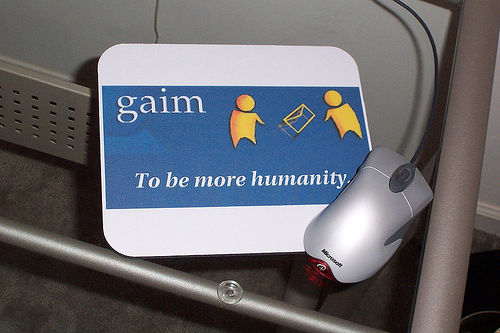
Gaim 2.0: multi-protocol instant messenger

Gaim is a multi-protocol instant messaging (IM) client for Linux, BSD, MacOS X, and Windows. It is compatible with AIM and ICQ (Oscar protocol), MSN Messenger, Yahoo!, IRC, Jabber (for example, Google Talk), Gadu-Gadu, SILC, GroupWise Messenger, and Zephyr networks.
Gaim users can log in to multiple accounts on multiple IM networks simultaneously. This means that you can be chatting with friends on AOL Instant Messenger, talking to a friend on Yahoo Messenger, and sitting in an IRC channel all at the same time.
Gaim supports many features of the various networks, such as file transfer, away messages, typing notification, and MSN window closing notification. It also goes beyond that and provides many unique features. A few popular features are Buddy Pounces, which give the ability to notify you, send a message, play a sound, or run a program when a specific buddy goes away, signs online, or returns from idle; and plugins, consisting of text replacement, a buddy ticker, extended message notification, iconify on away, spell checking, tabbed conversations, and more.

Gaim runs on a number of platforms, including Windows, Linux, and Qtopia (Sharp Zaurus and iPaq).
The last release of Gaim is Gaim 2.0 Beta 2 (Windows download).
For other platforms, download Gaim from here.
To configure Google Talk to work with Gaim, check this guide.
Subscribe to:
Comments (Atom)
