After the famous discovery that Google Public Search is vulnerable to phishing, Google decided to redirect all the pages hosted there to googlesyndicatedsearch.com. This way, the sites can't read the cookie for google.com and don't appear reliable enough to enter your credentials.
"Google University Search customers have complete control over the header and footer html. Create the Header HTML to fit the look & feel of your site." Unfortunately, the service is still unavailable.
The problem with user-generated content is that it can contain malicious code and that visitors can be easily mislead into thinking that Google owns the site and is responsible for the content.
October 4, 2006
Behind Google Q&A
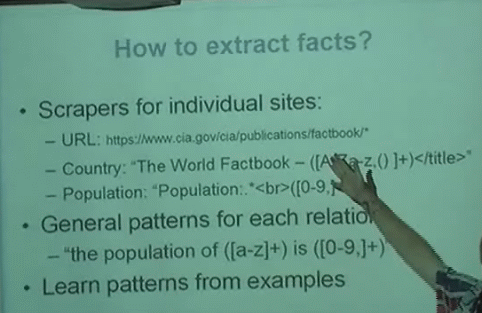
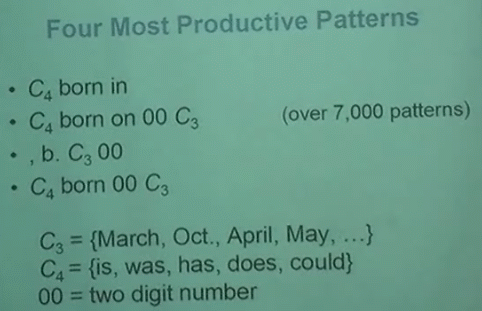
Peter Norvig gave a talk at UC Berkeley on September 25. Among other things, he talked about some Google projects that use artificial intelligence. He also said that a large corpus of data can be much more valuable than an efficient algorithm. One example of project where Google uses a lot of data is Google Q&A, that is extracting facts from web pages and delivering as answers to common questions like "what is the population of Japan?". Google doesn't use predefined patterns, they find the patterns from examples, as this approach is more scalable. They extract data by matching the patterns against the top results for a query.
The presentation is available online (MMS stream).
The presentation is available online (MMS stream).
October 3, 2006
Include Google Gadgets Into Any Page
Google announces that some of the gadgets available for Google Personalized Homepage can be embedded into any web page. The list of the gadgets includes: Google Calendar Viewer, Google Calculator, US Traffic Information, Moon Phase, Picasa Album Viewer and more. This way, you can enrich your web page with live information.
Google gives an example of usage:
"For example, let's say you are in charge of your club soccer team's website, and you want to add a current weather forecast so your fans can plan for your games or you want to include a daily brainteaser on your site without having to come up with something new every day. Google Gadgets lets you do this easily. Just visit the directory of "Google Gadgets for your webpage" to find gadgets that you'd like to add to your own page and select your preferences for how the gadget will appear on your page. Then, copy and paste the HTML from the window into the HTML code for your own website. It's an easy way to get the content you need and want without spending hours writing code!"
Previously, some gadgets could be included in Google Page Creator if you selected the experimental features.
Google gives an example of usage:
"For example, let's say you are in charge of your club soccer team's website, and you want to add a current weather forecast so your fans can plan for your games or you want to include a daily brainteaser on your site without having to come up with something new every day. Google Gadgets lets you do this easily. Just visit the directory of "Google Gadgets for your webpage" to find gadgets that you'd like to add to your own page and select your preferences for how the gadget will appear on your page. Then, copy and paste the HTML from the window into the HTML code for your own website. It's an easy way to get the content you need and want without spending hours writing code!"
Previously, some gadgets could be included in Google Page Creator if you selected the experimental features.
Clean the Labels from Google Video
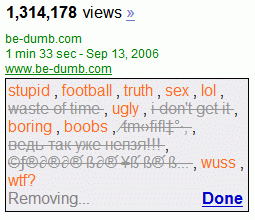
Google should have taken the time to explain the role of the labels and should have displayed only popular labels, the same way they do in Google Image Labeler.
October 2, 2006
Do Questions Lead to Innovation?
Google's CEO, Eric Schmidt, talks about Google's plans and their partners in an interesting interview from Time. He also explains that people at Google put a lot of questions, some of them leading to ideas and new products.
We run the company by questions, not by answers. So in the strategy process we've so far formulated 30 questions that we have to answer. I'll give you an example: we have a lot of cash. What should we do with the cash? Another example of a question that we are debating right now is: we have this amazing product called AdSense for content, where we're monetizing the Web. If you're a publisher we run our ads against your content. It's phenomenal. How do we make that product produce better content, not just lots of content? An interesting question. How we do make sure that in the area of video, that high-quality video is also monetized? What are the next big breakthroughs in search? And the competitive questions: What do we do about the various products Microsoft is allegedly offering? You ask it as a question, rather than a pithy answer, and that stimulates conversation. Out of the conversation comes innovation. Innovation is not something that I just wake up one day and say 'I want to innovate.' I think you get a better innovative culture if you ask it as a question.
SearchMash, a New Google Search Site

SearchMash is a low-profile site created by Google, that mixes Google Search with Google Image Search and adds some interesting features. The concept is similar to the old A9.
Search results are numbered and you can reorder them. Clicking on the green URL, you'll see a list of options like "cached copy", "similar sites". You don't have click on the search box to type your query. There is no search button, you just have to type enter. Google shows the number of visible search results in the top right corner. Clicking on the "more" link, Google loads a new set of results using Ajax and scrolls to the first result of the new set using a nice animation (this seems broken in Firefox). Actually the entire site uses a lot of JavaScript and Ajax, and it can't be used if you disable JavaScript.
For the moment, SearchMash is a playground for small ideas that could be the foundation of an entirely new Google site. Although this site is mainly for Google testers, it's interesting to see it growing.
{ Found by Pete Warden, who has an interesting site called... SearchMash. Via Blogoscoped Forum. }
Related:
Restrict your search to your favorite sites, soon at Google
Google Base Store Connector

Google Base Store Connector is a migration tool that allows you to export product information from online stores hosted by eBay, Amazon or Yahoo to Google Base. Google explains: "Google Base Store Connector is a free download that puts info about your store into our index, so that when people search Google for the products you have to sell, you'll show up in their search results, along with a link directly to your site on eBay, Amazon or Yahoo."
Google spends a lot of time lately getting ready for their big December launch. The launch of Google Base API, this migration tool and some additions to Google's robots.txt suggest that Google tries really hard to be successful in the shopping area.
What Does Britain Mean to Children?
Google had a competition in Britain called "Doodle 4 Google". Kids were asked to "design a Google doodle explaining what it means to be British today". The jury selected the top 30 doodles and now Google wants to know what do you think about their creations. The winning entry will be featured on Google UK homepage.
You may not be British, but you can still try to vote for your favorite doodles. Maybe Google won't take your vote into account, but you'll enjoy some nice logos like this one...

Update: here are the winners.
You may not be British, but you can still try to vote for your favorite doodles. Maybe Google won't take your vote into account, but you'll enjoy some nice logos like this one...
Update: here are the winners.
Google Buys Its First Office
Google has bought "the Silicon Valley home where co-founders Larry Page and Sergey Brin rented a garage eight years ago" and started the company, reports AP. They'll pay an undisclosed amount to Susan Wojcicki, who is now Google's Vice President of Product Management.
Google talks about its history in a hilarious way: "In September 1998, Google Inc. opened its door in Menlo Park, California. The door came with a remote control, as it was attached to the garage of a friend who sublet space to the new corporation's staff of three. The office offered several big advantages, including a washer and dryer and a hot tub. It also provided a parking space for the first employee hired by the new company: Craig Silverstein, now Google's director of technology."
The house is barely visible in Google Maps and it's already a touristic attraction. "We plan to preserve the property as a part of our living legacy," said Google spokesman Jon Murchinson.
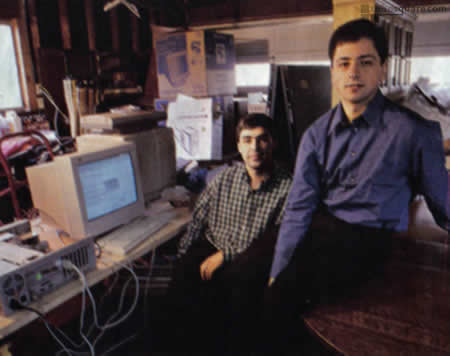
{ Image from thirdsquare.com: Sergey Brin and Larry Page in their office-garage (1998).}
Google talks about its history in a hilarious way: "In September 1998, Google Inc. opened its door in Menlo Park, California. The door came with a remote control, as it was attached to the garage of a friend who sublet space to the new corporation's staff of three. The office offered several big advantages, including a washer and dryer and a hot tub. It also provided a parking space for the first employee hired by the new company: Craig Silverstein, now Google's director of technology."
The house is barely visible in Google Maps and it's already a touristic attraction. "We plan to preserve the property as a part of our living legacy," said Google spokesman Jon Murchinson.
{ Image from thirdsquare.com: Sergey Brin and Larry Page in their office-garage (1998).}
Restrict Your Search to Favorite Sites, Soon at Google
Time has an interesting article about Google called Google's Growing Grasp. One interesting scoop is that: "Marissa Mayer, who manages search products, says the company has assigned more engineers to search than ever before and plans to release a new search tool that will enable users to design and build their own flavor of Google search, scanning just the sites they're interested in."
This seems related to the new domains recently bought by Google: search-mashups.com, mashsearch.com and other similar domains.
MSN Search (Windows Live Search) already has search macros, that allow you to define a list of sites where you'd like to search (for example, sites about recipes). Rollyo lets you define a list of trusted sources and create your own search engine using results from Yahoo.
So we should expect a similar offering from Google, that will most likely include a way to share your search mashups that combine content from more than one source. Until then you can already do that, albeit not in an elegant way.
This seems related to the new domains recently bought by Google: search-mashups.com, mashsearch.com and other similar domains.
MSN Search (Windows Live Search) already has search macros, that allow you to define a list of sites where you'd like to search (for example, sites about recipes). Rollyo lets you define a list of trusted sources and create your own search engine using results from Yahoo.
So we should expect a similar offering from Google, that will most likely include a way to share your search mashups that combine content from more than one source. Until then you can already do that, albeit not in an elegant way.
Subscribe to:
Comments (Atom)

